
Report

When AI becomes the interface: Who owns the conversation?

Kemp Attwood
CCO, Founding Partner

Foreword

Last year, I gave a talk at a design conference about how AI was revitalizing my creative practice. I found myself shipping ideas through tools and prototypes I wasn’t able to before. That freedom returned me to the joy of making—the same joy that got me into this work in the first place.

In the months since, I’ve heard countless stories that mirror my own. Not only are my colleagues experiencing this unlock, but friends across various professions have described a similar boost of creativity. This isn’t the only story to be told about AI in the workplace, but it does illustrate one of the upsides of these new capabilities. An upside that is already beginning to reshape how we create, think, and interact.

What starts as a creative unlock quickly becomes something else. When people experience systems that understand them, respond fluidly, and help them think, those expectations carry over into the products and services they use every day. Customers are beginning to expect the ease and flow they have with ChatGPT or Claude, and will increasingly gravitate toward brands that can meet them in that kind of exchange. 

That shift raises a deeper question. If customer experience is no longer something designed in advance but something generated in the moment, who owns that interaction?

In the following report, we explore what this shift means, how adaptive experiences work, and why brands that build and own this layer will define what’s next for customer relationships—and what it takes to bring that same sense of possibility into the experiences they create.

Kemp Attwood
Founding Partner & CCO

Introduction: The adaptive shift

For most of the twentieth century, customer experience was broadcast—one-directional, and largely the same for everyone. The internet introduced interactivity, enabling dialogue between brands and customers. 

This evolved into predictive systems that tailor experiences to individual preferences. Netflix lines up our favorite show and Spotify knows our tastes and suggests artists based on past behavior. We no longer have to go looking. The experience comes to us, surfacing what we might want before we ask.  

We are now entering a new phase: adaptive systems.

AI has changed what interaction feels like. In just a few years, we've grown used to responses that feel less like search results and more like a conversation. AI is turning customer experience from something designed in advance into something that responds to you specifically, in the moment you need it.

Adaptive experiences are generated in real time, shaped by the full context of an exchange. They are not retrieved from a predefined set of possibilities. Each interaction is specific to the individual, created in the moment, and informed by what came before.

In an adaptive experience the user expresses intent, the system provides a unique response, and that response feeds the next expression of intent.

In this model, the value moves from the interface or content to the exchange itself, which is dynamic, contextual, and continuously evolving. Each interaction becomes unique and compounding, building a relationship that becomes more precise and personal over time.

This shift fundamentally changes how brands engage customers: from designing journeys in advance to participating in live, intelligent dialogue. The critical question is who owns that dialogue.

The stakes: The relationship layer is up for grabs

AI is becoming the interface through which customers interact, discover, and decide.

If that layer is mediated by third-party platforms, brands risk losing control of the relationship—along with their voice, their data, and direct access to their customers.

In the past, brands owned the relationship through their products, channels, and platforms. Now that the relationship is increasingly shaped in the interaction itself. As that exchange becomes the primary interface, ownership of it becomes the defining source of competitive advantage. 

Once the relationship is owned by someone else, it is difficult to take back.

Over the past decade, many brands have given away ownership of the customer relationship to social platforms. They gained reach, but lost direct access, insight, and control. What followed was a dependency that proved difficult to reverse.

The shift to adaptive experiences raises the stakes further.

The opportunity: Own the adaptive interface

The opportunity is to own the adaptive interface between brand and customer. Whoever owns that layer owns the relationship, the learning, and the value it creates.

These experiences create a form of differentiated advantage that cannot easily be replicated. Because differentiation emerges through interaction—shaped by a brand’s data, systems, and relationships—it becomes specific to that exchange and compounds over time.

When brands build their own adaptive experiences, the difference is significant. They maintain their voice and values, unfiltered by third-party platforms. They learn directly from customers, not through intermediaries. And they create relationships that evolve over time, becoming more relevant, more personal, and more valuable with every interaction.

It can feel like a significant shift, but getting started doesn’t require starting from scratch. Most brands already have what it takes to begin: a deep understanding of their customers, a body of knowledge built over time, and a relationship grounded in trust. 

The conditions are in place and customers are ready. The question is whether brands will define this layer themselves, or let someone else own the relationship.
The how: Designing adaptive experiences

In adaptive systems, the experience is shaped in real time through interaction. The role of design shifts accordingly: from mapping journeys to shaping the conditions in which value can emerge through the exchange.

Instead of structuring fixed paths, adaptive experiences are built by focusing on three core capabilities: gathering intent, activating intuition, and building emotional connection.

Together, these capabilities create the conditions for experiences that are responsive, contextual, and continuously evolving—even when the exact outcome cannot be predicted in advance.

1. Gather Intent

Most AI experiences still begin with an empty text box, placing the burden on the user to articulate everything in words. It’s a rudimentary interface element that assumes users know exactly what they want and can express it clearly, rather than helping them uncover it.

But the richer the intent a system can gather—through visual inputs, behavioral cues and contextual signals—the less it has to assume, and the more relevant and precise the response. Interfaces that invite context, preference and nuance transform a query into a conversation; one where users can refine, decide and act, all within the same flow.

Imagine Jamie and a friend are planning a trip together. Instead of asking for fixed choices upfront, such as exactly where you want to go, the adaptive experience begins with nuanced signals of intent. Unlike a standard form, choices can be made on a spectrum, in this case, beginning with the general nature of your ideal trip and what type of traveler you are.

2. Activate Intuition

Instead, it returns something that helps people understand what they actually mean and spark thinking beyond their original intent. It interprets what users actually want and treats every response as an opportunity to carry the conversation forward.

In the context of a travel app, before suggesting a destination the system responds with travel experiences that match that reflect the interests and travel profiles of both friends. The destination is then presented with an overview of the trip highlights. If the friends are unsure, it offers more ways to explore. The result is a conversation that moves toward a decision together, rather than simply returning an answer.

3. Build emotional connection

One of the most valuable things a brand can shape is how it makes people feel. In adaptive experiences, that feeling is the byproduct of every exchange. Designing for emotional connection means defining a brand’s personality clearly enough that its boundaries, values and signals come through consistently across different moments, moods and people. Think of it as designing a wardrobe rather than a single outfit.

In the travel app, the system already knows Jamie’s past trips, travel history, and even that he communicates with emojis. The itinerary arrives with a knowing tone, already anticipating the next step. For a new user, the same screen is warmer and more considered. The destination is the same, but one conversation feels like catching up with someone who knows you, while the other feels like being genuinely looked after for the first time.

Together, these three capabilities create the conditions for adaptive experiences to work as intended: systems that start with understanding rather than assumption, turn every response into an invitation to think further, and build a relationship where past conversations are remembered.

Now, it’s possible to create experiences rooted entirely in a brand’s own perspective, knowledge and values; building direct relationships that grow deeper and more valuable with every interaction. 

And for most brands, that’s well within reach.

In practice: Building adaptive relationships

You don’t have to build everything at once. Adaptive experiences can be introduced incrementally alongside what already exists.

Brands can begin at one of three levels. A single exchange that generates something unique, a session where earlier turns inform later ones, or a sustained relationship where the system learns across time and develops a genuine understanding of the customer.

Each represents a different depth of commitment, and each delivers a different quality of relationship.

Single creates relevance.
Session builds trust.
Sustained fosters partnership.

1. Single: One exchange, one response.

Each input is a fresh statement of intent. The system generates something unique to this person in the moment, but the conversation does not carry forward. There is no memory of what came before.

What makes this genuinely adaptive is that the response could not have existed before the customer arrived. It was not waiting to be served. It was created in the exchange, making every interaction immediately relevant to the individual in front of it.

Pentagram's online archive, a collaboration with AREA 17, spans five decades of work from one of the world's most influential design practices. Rather than browsing by category or scrolling chronologically, visitors can search using natural language.

Simply type a concept, a feeling, a theme or a question and the system returns a unique set of results shaped entirely by that input. Someone searching for “red posters” will find something entirely different from someone searching for “warmth” or “hand drawn.” A designer researching typographic history will arrive somewhere different from a student exploring brand identity. 

The archive is the same for everyone, but the experience of it belongs to whoever is asking.

2. Session: Dialogue within a sitting

Earlier turns inform later ones. The system holds the thread of the conversation and each response is shaped by everything that came before in that session. The experience deepens as it goes. 

A customer who arrives with a vague sense of what they want can leave with something specific, having been guided there through genuine exchange rather than a predetermined path. The value is not just in the response, but in how the system helps the customer arrive at something they could not have defined at the start.

Brunello Cucinelli's online store is built around the brand's philosophy as much as its products. Rather than browsing a catalogue, customers enter a conversation. The experience draws on the brand's own content, editorial, and values to guide discovery.

Ask what you're looking for and the system responds in the brand's own voice, surfacing products, and building a picture of your interests. Earlier turns in the conversation inform later ones so that the recommendations feel less like search results and more like the considered suggestions of someone who has been listening.

3. Sustained: The system learns across sessions

Past exchanges become context for future ones, and over time, the experience becomes something that couldn't exist without the history between them. A returning customer is continuing, not starting again. 

The relationship has texture, history and a direction of travel that belongs to them alone. Over time, this creates a relationship that is not just personal, but difficult to replicate.

Pfizer Health Answers is a consumer health app that lets people ask medical and wellness questions in plain language. The experience is designed for the moments between appointments, providing answers grounded in verified independent sources.

Users build a health profile over time, and the system uses that context to personalise its responses to their specific situation. A question about managing cholesterol reads differently for someone in their forties with a family history of heart disease than it does for someone asking on behalf of an elderly parent. The more the system knows, the more precisely it can respond. A curated feed of relevant content surfaces alongside answers, shaped by what each person has shared and explored before.

The three levels above describe how deep an adaptive experience can run over time. But depth alone doesn't capture the full potential of adaptive experiences. At its most powerful, the system becomes a genuine creative collaborator—helping the customer bring ideas to life.

Report wayfair

Wayfair is a good example.

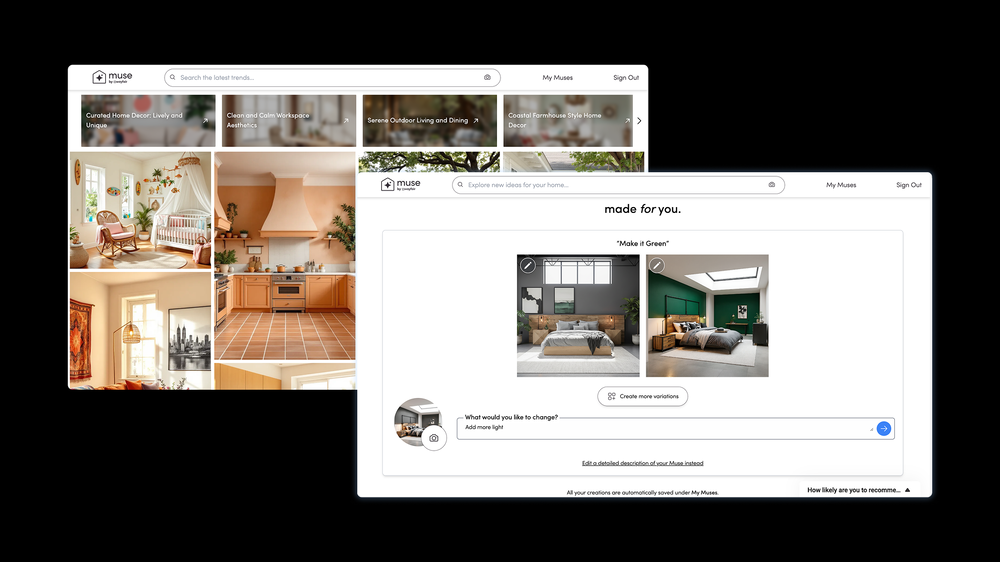
The AI-powered visual discovery tool from the American home goods retailer bridges the gap between abstract ideas and practical design, connecting users with Wayfair's extensive product catalogue. The best way to understand the possibilities it unlocks is to follow a single exchange from beginning to end:

When someone moves into a new apartment, they usually want to decorate it in a way that suits them and their lifestyle. They collect vinyl. They are drawn to things with a bit of history. They know the feeling they are after but could not describe it in a product search. They open Wayfair Muse and type: warm, a little retro, lived in but not cluttered. The system generates a room. They respond: push the color warmer, make the record player more of a feature, less minimalist vibes. The system adjusts. The conversation continues. Each exchange produces something closer to a space that feels like theirs.

Then something unexpected happens. The system suggests a William Morris wallpaper. Bold, patterned, nothing like the restrained retro feel the user had been building toward. They pause. It is not what they asked for, but something about it works. The room suddenly has an element to it they would never choose normally. They go with it.

This is the creative collaborator at work. The system gathered intent not from a product search but from a feeling expressed in natural language. It activated intuition by generating something that opened the exchange rather than concluded it. And throughout, the experience felt like it came from somewhere specific, with a point of view. 

The customer who discovered the William Morris wallpaper had an experience that felt personal, surprising and specific to them. A competitor can match a price. They cannot replicate a relationship strengthened through interaction. This is where adaptive experience moves beyond optimization into something more valuable: a system that doesn’t just respond, but helps shape taste, preference, and decision-making over time.

Closing: Beyond the interface

The shift from predictive to adaptive is already underway, which is in turn changing the role of brands. Customer experience is no longer something designed in advance—they are now active participants.

Most brands already have the foundations to build on: proprietary knowledge, a deep understanding of their industry and customers, and trust that has already been earned. 

The window is wide open for brands to turn this advantage into a new layer of experience that becomes more valuable with every exchange, and compounds over time. Brands that step into this exchange early on will own the relationship, insights, and value it creates. Those who leave it to others will find it increasingly difficult to take back.

The adaptive shift redefines what a relationship between a brand and its customer can be. The only question left is who will own that dialogue.

Credits

This report is based on a talk given by Kemp Attwood and the collective research, thinking and craft of the AREA 17 team.

Core report team

Up next