
Every day, your customers ask questions your systems can’t answer — not because you lack data, but because you haven’t taught your systems to listen. For most of the internet’s history, search was mechanical.
Users typed keywords; systems returned lists. The path was predetermined, the website the final stop. It was functional, but not intelligent.
That era is over.
AI has remade search into something alive — a dynamic system that listens, interprets, and adapts in real-time. Users no longer follow links; they enter conversations. Across platforms like ChatGPT, Perplexity, and Gemini, discovery has evolved into dialogue.
Search no longer simply points the way; it participates in the journey.
This shift marks a fundamental change in digital experience. Search has become the connective tissue between brand, product, and data — a living interface that reveals how well an organization understands the people it serves.
The adaptation creates three urgent realities for leaders:
The Problem
The search expectation gap
Users now expect every search experience to feel conversational and intelligent, yet most in‑product systems still think in keywords.
The Shift
Search moves inside
Discovery is moving into the product itself, powered by specialized AI that learns from your own data, rather than competing for rank elsewhere.
The Opportunity
Your data is your advantage
Years of proprietary knowledge can become the foundation for differentiated AI experiences — if you teach your systems to use it.
For leaders, the message is clear: search is becoming a central part of your product infrastructure. Understanding the gap, embracing the shift, and recognizing the opportunity sets the stage — but the real question is how to transform search into a living, intelligent system.
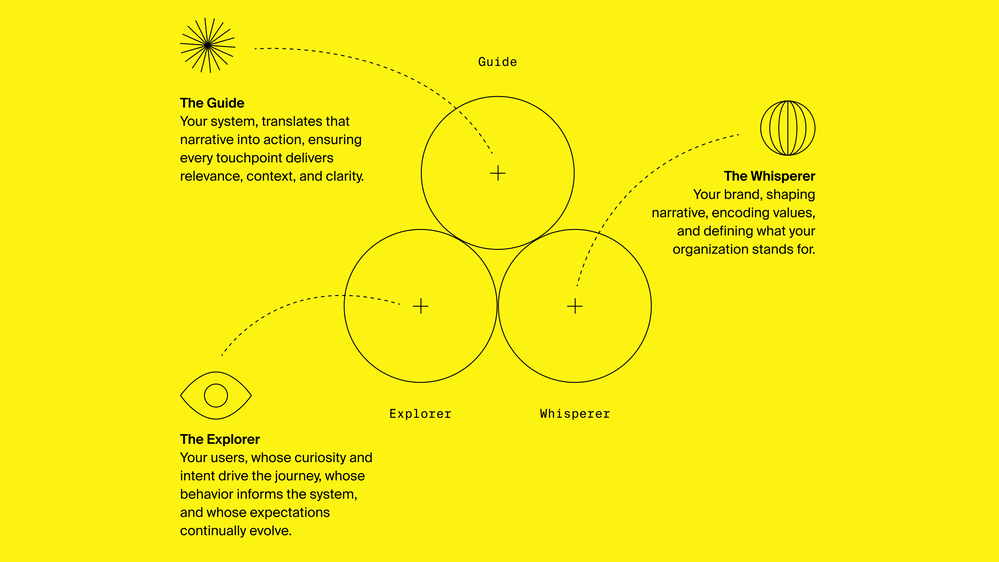
The framework that follows illustrates how to turn search into intelligent discovery: a system that learns, speaks, and earns your trust on your behalf. We’ll explore these three currents in depth — the expectation gap, the internal shift, and the data advantage — and offer a framework for turning them into an intelligent discovery system.
Neglect this adaptation and the consequences are real: you risk losing visibility, trust, and user loyalty to external platforms that understand users better and speak louder than your own product ever could. Those who teach their systems to listen will lead; those who don’t will disappear into someone else’s results.