Part II: Closing the intelligence gap
Rethinking work for the intelligence era

George Eid
Founder, CEO
This is part II of “Rethinking work for the intelligence era,” a two-part series exploring why organizations struggle to turn insight into action—and how they can close that gap. Part I is here.
Foreword
When the internet was new, we explored. The late ’90s web was raw—pure curiosity and invention. Then the bubble burst. Those who stayed either chased the next wave of hype or served the medium on its own terms. We chose the latter.
As the internet matured, the 2000s became about getting things right. We helped set the standards the early web lacked, and influential clients hired us to bring rigor and clarity to their most critical work.
Each disruption—social media, mobile internet, cloud computing—was real but navigable because the internet’s underlying logic was becoming more standardized. New standards emerged, and we adapted alongside them. For two decades, certainty was the currency—not because the world stood still, but because it remained mappable.
That world is gone.
Today, change outpaces standardization. The playbook cannot be written fast enough. Nobody knows what works. Not agencies, not consultants, not the people who built the tools. We’re back to the mid-’90s—making it up as we go—but at a speed and scale that makes that era look gentle.
AREA 17 felt this tension directly. Not in the quality of our work, but in the absence of the map. As an organization, we could see what was changing. But we had no playbook for it. Translating what we knew into action took longer than it should have. We started asking uncomfortable questions.
Are we becoming irrelevant? Can an organization built on certainty redesign itself for a world where certainty no longer exists? That means changing how we operate, not just what we offer.
Expertise itself needs to be redefined. Knowing the right answer is no longer enough. What matters now is the ability to act well under uncertainty and learn faster than the environment changes.
Part I described how industrial systems were designed for efficiency at the expense of adaptability. Part II is about what we’ve learned from our own ongoing experience and from encountering the same structural limits across the organizations we help shape.
George Eid
Founder, CEO
How work is designed against flow
Most people know what flow feels like: that moment when you understand why the work matters, you have the autonomy to act, and you can see the impact of what you do. Awareness is heightened, execution is fluid, and each action informs the next.
An hour in flow can feel like days of progress.
Flow emerges when intelligence moves freely—from signals into action, from action into feedback, and from feedback into what gets noticed next. A jazz ensemble makes this visible. Musicians who play together regularly build collective intelligence that no individual possesses alone. They anticipate each other, recover from mistakes fluidly, and respond to signals in real time. That capacity doesn’t belong to any one musician. It belongs to the system.
In most organizations, intelligence doesn’t flow freely. The signals are there—in market shifts, customer behavior, team frustration, strategic drift. But no matter how clear the signal, how sound the analysis, how aligned the room—nothing changes.
This is the intelligence gap—the structural distance between what an organization understands and how quickly that understanding translates into action.
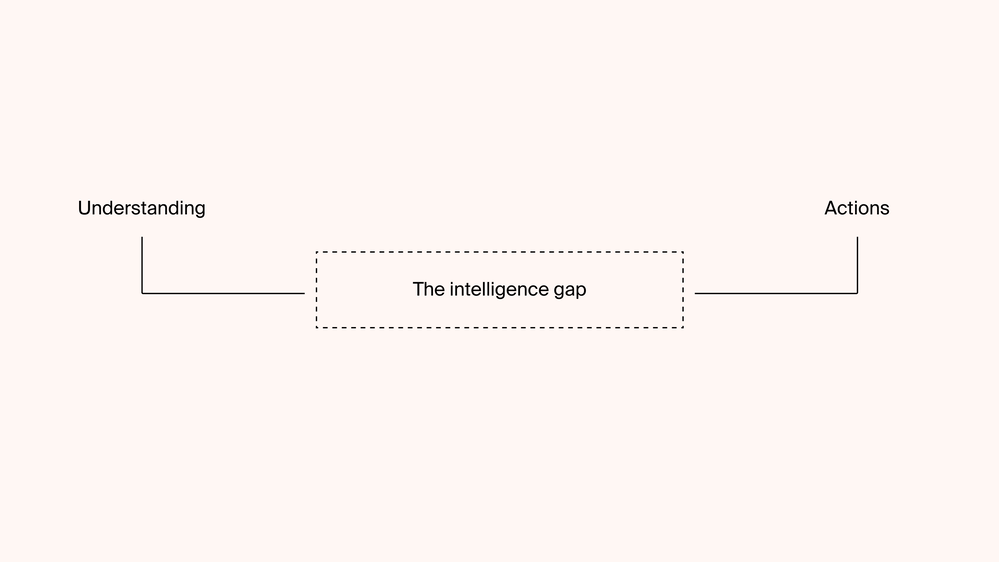
Strategy is defined in one group, translated in another, executed somewhere else, and measured after the fact. By the time intelligence reaches the people who can act on it, it has been filtered, summarized, and delayed to the point that it no longer retains its original value.
The organization keeps moving, but it stops adapting.
Transformation programs, new methodologies, and now AI—each arrives as the answer but leaves the underlying structure intact. The gap persists. In some organizations, it widens.
The intelligence gap is the structural expression of the industrial-era assumption that has never been fully abandoned: that human judgment is a liability to be managed rather than a capacity to be developed. Management practices evolved, but in most organizations, the underlying logic did not.
Closing the gap requires restoring the conditions under which judgment develops—the kind that only comes from making consequential decisions and living with the results. Used well, AI deepens those conditions. Used as a replacement, it removes the very thing organizations need to adapt.
Judgment is what makes adaptability real. And adaptability produces durable success in unpredictable conditions—not by being right in advance, but by adjusting when you’re not.
This article is about those conditions: what stripped them away, what continues to remove them, and what restoring them requires.
Why adaptability remains out of reach
Industrial systems were designed in ways that removed the conditions that make intelligence flow: the context to understand why signals matter, the authority to act on what you sense, and feedback close enough that each action informs the next. What it left behind was a system too fragile to adapt.
Most leaders are acutely aware of the problem and respond with programs, training, and the latest methods. Quality movements made processes more reliable. Agile methodology made teams more responsive. Lean practice accelerated iteration. Each produced real improvements, but solved the problem at the team level without changing the underlying structure. Strategy was still set above, budgets still allocated centrally, and success still measured by output. Intelligence still couldn’t flow throughout the organization because the underlying conditions remained unchanged.
A capability is hireable, purchasable, and trainable. You can adopt an agile framework. You can run a workshop on adaptive thinking. None of it makes the organization adaptive because the capability belongs to the person, not to the system around them. When the person leaves, or the program ends, the capability goes with them.
Adaptability is a property of the system—the conditions that shape what people can do and what they’re held accountable for. A highly adaptable leader within a rigid system cannot make the system more adaptable. The system overrides the individual. Leave the conditions unchanged, and even the most capable people will conform to what the system rewards.
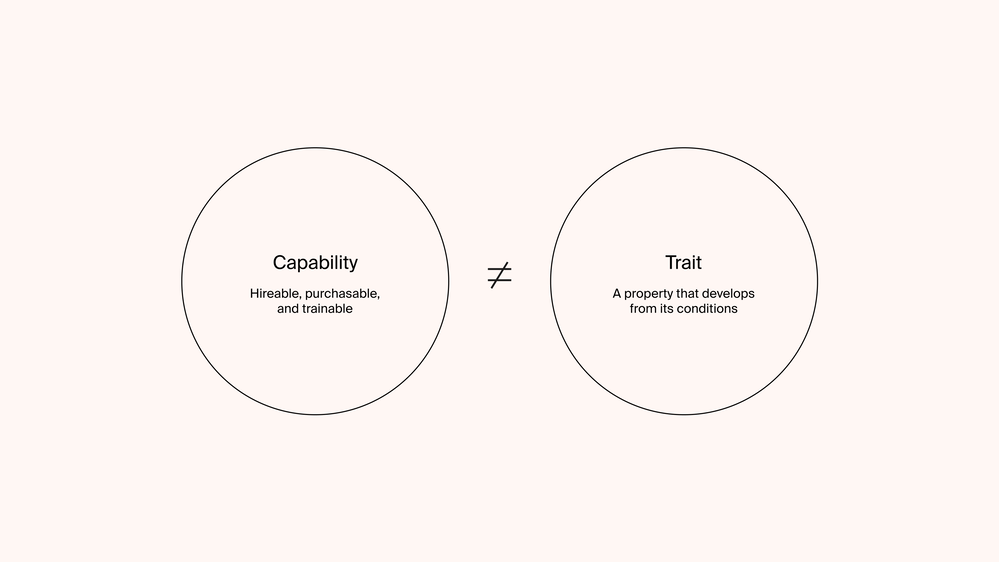
Adaptability is a trait, not a capability. You can’t hire it, buy it, or teach it into existence. It develops through repeated exposure to real conditions over time.
The immune system doesn’t become resilient because a single cell is particularly capable. It becomes resilient because the system has cycled through enough real encounters that resilience is now structural—distributed across the whole, present even when individual parts change.
Every system trains people. The only question is: into what? The answer depends on the conditions the system creates, and whether those conditions treat human judgment as a liability to manage or a capacity to develop.
Stakes are the mechanism
The forest doesn’t become fire-resistant by studying fire. It becomes fire-resistant because the fire was real. The stress was genuine, the recovery necessary, the trace left behind structural. Remove the fire, control the conditions entirely, and the forest loses the very trait that made it resilient. Not immediately. Gradually. The bark thins. The roots grow shallow.
Stakes are the mechanism by which adaptability develops.
Adaptability isn’t about having the right answer in advance. It’s about developing the capacity to read situations accurately, act in the face of uncertainty, and adjust when outcomes differ from expectations. That capacity is judgment. And judgment only develops one way—through making decisions that carry real consequences.
Context makes stakes visible. Authority makes them personal. Feedback makes them real. When those conditions are present, failing to see, act on, or learn from something carries a visible cost. That’s how judgment develops.
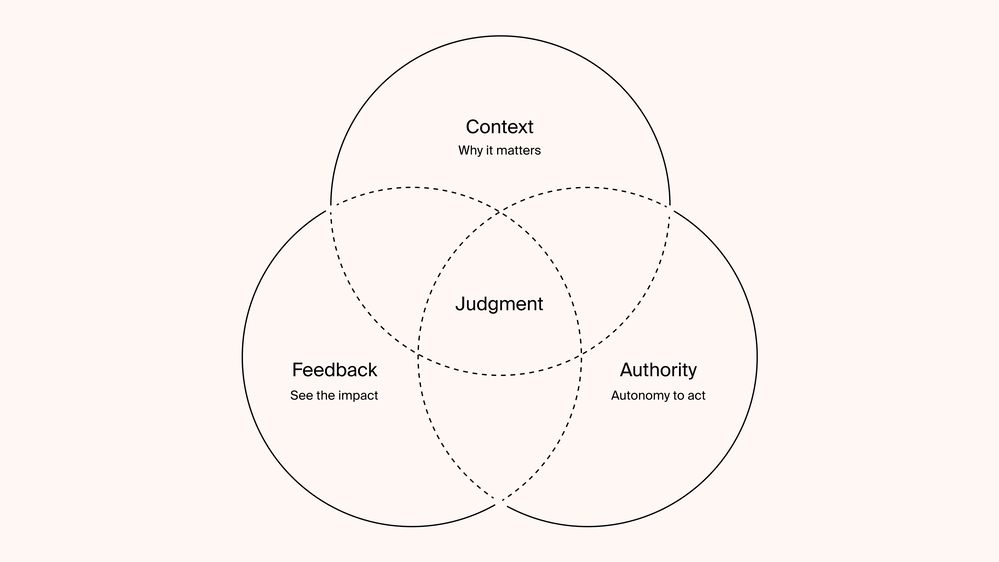
Organizations removed these conditions unintentionally while optimizing for efficiency. Specialized roles sharpened focus. Approval processes reduced risk. Reporting structures maintained quality. Each decision was rational. Together, they created distance between signal and decision, between action and consequence, and between learning and direction.
The result looks like normal work. Things get done, but underneath, something is degrading. Why sense what won’t be acted on? Why act when the outcome won’t be felt? Why learn when it won’t change direction?
Eventually, the measure of ‘done’ becomes whether it shipped, not whether it changed anything. Teams that could change course don’t, because the system punishes course correction and rewards delivery.
The goal isn’t to remove all friction. It’s to remove the kind that degrades judgment and restore the kind that develops it. When the wrong friction replaces the right kind, context, authority, and feedback disappear. Stakes become invisible, someone else's problem, and without consequence.
Without judgment, adaptability isn’t real. What erodes is the organization’s ability to respond—and the human capacity that would have enabled it: judgment developed through consequence.
The organization doesn’t stop adapting overnight. It calcifies—gradually, quietly—while the work continues.
What AI reveals
AI has made the intelligence gap impossible to ignore. It doesn’t create intelligence. It increases the organization’s capacity to act on the intelligence it already has. In a system where intelligence flows, that’s powerful. In a system where it doesn’t, it accelerates fragmentation.
As AI absorbs more workload, the instinct is to define human contribution by what machines can’t yet do. This treats human capabilities as temporary refuges—held until machines improve enough to absorb them too. It’s a shrinking definition and entirely the wrong frame. Human value isn’t machine shortfalls.
What separates humans from machines isn’t capability. It’s consequence—and what develops through it. Machines operate without consequence. There’s no cost to being wrong. No skin in the game. Machines can be reset. Humans live with what they decide.
That weight—the irreversibility of real decisions—is what forces judgment to develop.
Stakes—not just tasks—are what AI removes when it absorbs consequential decisions. The machine does the work. The human watches. But judgment doesn’t develop through observation.
AI compounds the problem in two ways. It compresses the time between signal and action—and when judgment hasn’t developed enough to act wisely, speed makes things worse. And it scales decisions across systems—a flawed pattern encoded into an AI system propagates across every decision it touches.
How organizations protect the space where human judgment develops—as AI accelerates everything around it—is one of the most important questions of this era.
The architecture of intelligence flow
Like a jazz ensemble, organizations where intelligence moves freely build collective intelligence no individual can possess alone. Teams anticipate each other, recover from mistakes fluidly, and adjust together as conditions change.
The capacity doesn’t belong to any individual. It emerges from systems that structurally connect intelligence over time.
When it’s working, you feel it at every level. Leadership adjusts direction based on what teams closest to the market are seeing, not what the last planning cycle decided. A product team acts on a signal this week rather than escalating it into a process that addresses it next quarter. Learning from one part of the organization reaches the people who need it before the same patterns repeat elsewhere.
The system metabolizes reality rather than defending itself against it. And this capacity has a specific architecture.
Sense—Make—Learn. Repeat.
Intelligence flows through three connected states: sensing, making, and learning. Sensing is detecting and interpreting signals. Making is deciding and acting on what you sense. Learning is absorbing the consequences back into the system.
Each state feeds the next and depends on the previous one. Sensing without making is observation that goes nowhere. Making without learning is action that repeats itself. Learning without sensing is reflection disconnected from reality.
Intelligence only flows when context, authority, and feedback remain connected across all three states.
Sensing requires context: the shared understanding of why signals matter and what the organization is trying to do. Without it, signals arrive but mean nothing—or mean different things to different people, producing fragmented interpretation rather than shared direction.
Making requires authority: the power to act on what you sense, and the space to fail and learn. Without it, people see what needs to change but can’t change it—producing paralysis of knowing without acting.
Learning requires feedback: results returning directly to those who acted, unfiltered and close enough to carry weight. Without it, consequences never reach the people who could use them—and the cycle begins again from the same base as before.
When those conditions are present, intelligence moves. When they’re absent, it doesn’t just slow—it distorts. The organization stops responding to what’s actually happening and starts responding to a processed version of it.
Where the loop broke
Industrialization broke the loop in three places. Each fracture removed one condition that allows intelligence to move.
1. The sensing fracture
Context never reaches those who need it
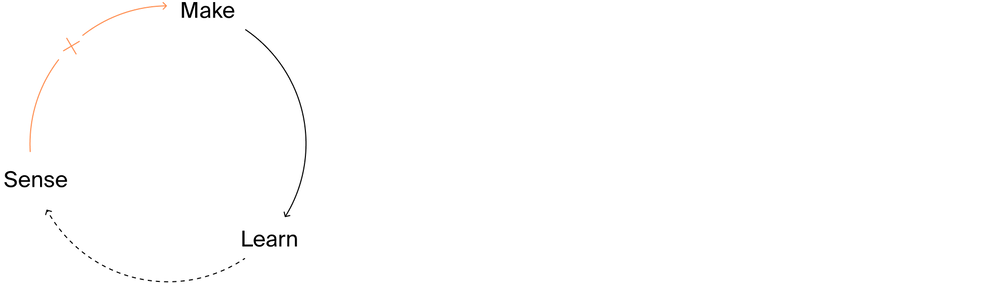
The people who sense can’t act on what they detect. The people doing the work wait for direction. Leadership waits for action. The structure produces the standoff.
What it costs: Purpose disappears through the accumulated experience of signals going nowhere.
The repair: The shorter the distance between signal and action, the more meaning survives. Diverse perspectives prevent collective blind spots.
With AI: Expands what an organization can see, or narrows thinking to a single perspective, amplifying blind spots.
When sensing is repaired, context is restored—and, with it, purpose. Signals reach the people who need them with their meaning intact. Purpose isn’t declared from above, but felt through proximity to what’s actually happening.
2. The making fracture
Authority never reaches those who act
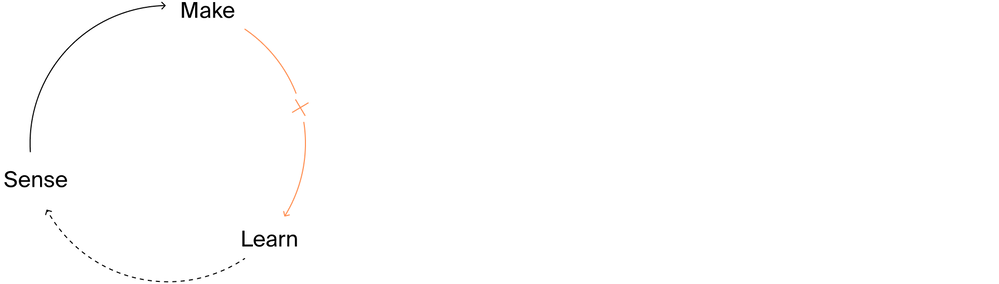
The people who act can’t influence direction based on what they see. The signals from their actions languish. The organization delivers more and understands less.
What it costs: Autonomy disappears through the repeated experience of seeing what needs to change and having no power to change it.
The repair: Every action generates information—but only when the people who act have the authority to act on what they see, and the space to fail and adapt.
With AI: Improves thinking through action when authority is present, or increases output without understanding.
When making is repaired, authority is restored—and, with it, autonomy. People have the authority to act on what they know without waiting for permission. Teams move at the speed of the environment, not the approval chain.
3. Learning fracture
Feedback never returns to those who acted
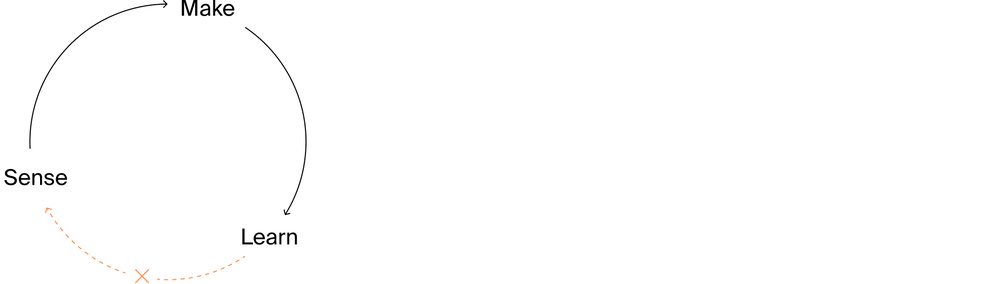
The people who learn can’t change what happens next. Insights accumulate. Behavior remains unchanged. The cycles continue without absorbing consequences.
What it costs: Mastery disappears through the repeated experience of acting without knowing what the action produced.
The repair: Pause to absorb what the last cycle produced, and ensure unfiltered learning returns to those who acted.
With AI: Connects learning to the decisions that need it, or absorbs the consequence, and people never feel it.
When learning is repaired, feedback is restored—and, with it, mastery. Consequences return to the people who produced them, close enough to carry weight and develop judgment. Each cycle leaves the organization more capable than the last.
Adaptability is earned through practice, not installed. Each cycle brings signal and response closer together. Signals reach people who can act. Decisions carry real consequences. Learning returns to those who acted. Stakes return. Judgment develops and, with it, the ability to succeed in conditions you cannot predict.
That's how the intelligence gap closes.
The intelligence you earn
We started this work because we felt the problem ourselves—not in the quality of what we built, but in how we were structured to respond. The intelligence was there. It just couldn’t move fast enough to matter.
Closing that gap has become leadership’s first responsibility: not being right in advance, but designing systems that create the conditions for the organization to adjust when it's no longer right.
The industrial era treated human judgment as a liability to suppress in the name of efficiency. AI risks repeating that mistake at a higher level, with less room to recover.
The question isn’t what work is left for humans after automation. It’s whether organizations will design systems that strengthen human judgment or systematically eliminate it.
We built AREA 17 in an era that rewarded certainty. We’re rebuilding it for one that rewards the ability to move. That means accepting that what made us successful will need to change—and that the measure of that change isn’t what we build next, but how quickly we learn from it.
The future of work won’t be defined by what machines can do. It will be defined by whether we build systems that expand what only humans can carry: judgment under consequence.